
Upholstery Cleaning in Balchik
Team
Payment
What is included in the service?
- Sofas and armchairs upholstery cleaning (incl. pillows);
- Chair and stool upholstery cleaning;
- Stain Removal: Tackling tough stains like food, drink spills, and pet accidents.
- Odor Neutralization: Removing unpleasant odors trapped in the fabrics.
How it works?
How long does the service take?
How long does it take for upholstery to dry?
How often should I wash the upholstery?
What's the expected end result?

Sofa & upholstery cleaning prices in Balchik
Transparent prices from cleaning companies serving Balchik, fixed at the time of booking. The service is performed at the customer's home — no need to transport the furniture.
- 1 sofa seat from 6 €
- 1 armchair from 7 €
- 1 chair from 5 €
- 1 mattress up to 100cm from 9 €
- 1 mattress over 100cm from 15 €
- 1 carpet up to 6m2 from 8 €
Prices are indicative, based on the lowest available offer from companies serving Balchik. The exact price for your sofa is confirmed at the time of booking.



Benefits beyond aesthetics: longevity, health, comfort
Professional upholstery cleaning yields multiple benefits:
- Aesthetic renewal Restores colour, removes grime and reduces obvious signs of wear.
- Extended lifespan By removing abrasive dust and corrosive residues that damage fibres, regular cleaning delays fabric deterioration and reduces the need for replacement.
- Improved indoor air quality Extracting embedded dust and allergen reservoirs reduces re-suspension of particles, supporting a fresher environment.
- Odour removal Eliminating the biological sources of smells rather than masking them leads to lasting freshness.
- Comfort and well-being Clean, dry upholstery feels better to use and contributes to the perceived cleanliness of the home.
Viewed as an investment, periodic professional cleaning is cost-effective when compared with earlier replacement due to neglect or irreversible damage.
How professional upholstery cleaning works (step-by-step)
A professional upholstery cleaning job typically follows a sequence of carefully controlled steps. Each step is designed to protect the fabric, maximize contaminant extraction and minimize residual moisture.
- Initial assessment and inspection Visual inspection to identify fabric type, construction, removable parts, seams, piping and areas of heavy soiling. Check manufacturer labels and care codes (W, S, W/S, X) to guide method selection. Assess stains, odours and any fabric damage. Discuss concerns with the client.
- Vacuuming and mechanical agitation Thorough vacuuming with upholstery tools to remove loose surface dirt and dust. Mechanical agitation (soft brushes) may be used to loosen embedded particles in textured or piled fabrics, taking care not to damage fibres.
- Colour fastness and material testing Spot-testing in an inconspicuous area ensures the chosen detergent and technique do not cause bleeding, colour change or fibre damage. A pH-appropriate product is selected based on the fabric and nature of the soil.
- Pre-treatment of stains and heavily soiled areas Enzymatic or targeted chemistry is applied to breakdown proteins, oils, greases and pigments. Dwell time is controlled to allow penetration without over-saturation.
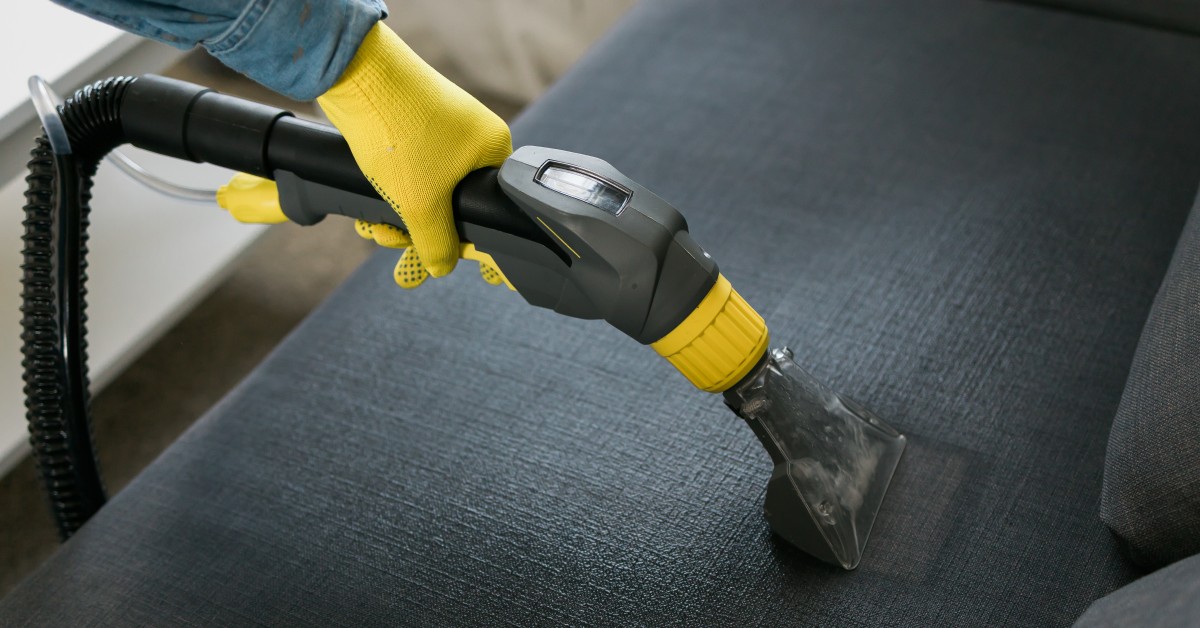
- Injection-extraction (hot water extraction / spray-and-extract) A controlled volume of warm water mixed with professional cleaning agent is injected into the fabric and immediately extracted with high-vacuum suction. This process removes dissolved soils from the fibre and the filling rather than simply wetting the surface. The aim is to use as little moisture as necessary to perform effective extraction and facilitate rapid drying.
- Supplemental steam or controlled heat where appropriate High-temperature steam can assist in breaking down fatty soils and reducing microbial load. It is used selectively where fabric type and testing permit. Steam is applied in controlled amounts and never as a substitute for extraction where moisture retention would be problematic.
- Targeted stain work and deodorization Persistent stains receive additional targeted intervention (solvent-based or oxidizing treatments as appropriate). Odour-neutralizing agents are used to eliminate the biochemical sources of smell rather than masking them.
- Residue rinsing and final extraction A rinse cycle may be performed to remove detergent residues that could attract rapid re-soiling if left behind. Final extraction emphasizes drying to reduce residual moisture in the filling.
- Drying and post-treatment care Air movers and controlled ventilation speed up drying. The goal is usually to achieve surface-dryness within hours and internal dryness within a day, depending on conditions. Fabric grooming (nap restoration) and repositioning of cushions are performed to return the piece to a ready state.
- Quality check and client walkthrough Inspect cleaned areas side-by-side with untreated sections if applicable. Discuss any limitations with the client, such as permanent stains or previously damaged fibres.
Each of these steps contributes to an outcome that balances cleanliness, fabric safety and drying speed. Proper sequencing, controlled chemistry and skilled extraction are what distinguish professional work from ad-hoc household cleaning.
Frequently Asked Questions
How much does sofa cleaning cost?
Pricing depends on the sofa type and number of seats — two-seat, three-seat, or corner. The exact price is fixed during booking and does not change.
Do you clean corner sofas?
Yes. Corner sofas are cleaned in full, including the chaise section and removable cushions. Each section is treated separately based on its level of soiling.
Do you clean sofas at the customer's home?
Yes. The service is performed on-site at the customer's home — no need to transport the furniture.
How long does sofa cleaning take?
Typically 30–60 minutes of on-site work per sofa. Drying takes 4–8 hours depending on ventilation and fabric type.
What is the price?
Each company sets its own prices. For the first time in Domestina, companies are in direct competition, their offers are visible on one screen. This enables users to get the best deal for the work they need.
Does the weather have to be warm to book the service?
Absolutely not necessary. After treatment, the surfaces remain slightly moist and dry out in a matter of hours depending on how dirty the upholstery was. Of course, in warm weather, the upholstery will dry out a bit faster, but it's only a matter of a few hours difference.
How long does it take for the upholstery to dry?
The drying time depends on the fabric type, the level of dirt, and room ventilation, but in most cases, upholstery dries within 6 to 12 hours after cleaning. If needed, you can speed up the drying process by increasing air circulation, such as by opening windows or using fans.
How to select a cleaning company?
Domestina marks the best choice for your cleaning with the Recommended Choice badge. Based on multiple criteria that are an expression of persistency, professionalism and expertise and cost, the platform identifies the best choice for your cleaning.
Can all types of upholstery be cleaned?
Yes, most types of upholstery fabrics can be cleaned using professional equipment, including delicate materials like velvet or silk. However, it’s essential to communicate any specific fabric care instructions or concerns with the cleaning company when booking. They will adjust their approach accordingly to ensure safe and effective cleaning.
Is stain removal included in the service?
Yes, stain removal is part of the standard service. The professional equipment used by Domestina's cleaning companies is designed to treat common stains from food, drinks, and pets.
Do all stains disappear?
Although our technology is among the best, there are so-called 'permanent damages' — when the stain has altered the structure or color of the fiber itself (for example, hair dye or bleach). In 90% of the remaining cases, the result is complete removal.
Is the cleaning safe for pets?
Yes. Our methods are entirely safe. It is only important to restrict pets' access to the furniture until it dries completely, to avoid them tracking in dust with their paws.
Can leather be washed?
Yes, Domestina offers specialized cleaning for genuine leather as well, but the method is manual and involves professional conditioning balms rather than extraction.
How do I prepare before the team arrives to clean my sofa?
It is ideal to clear the area around the sofa (side tables, fragile objects) and gather personal belongings from the cushions/seat. This way, the team can work more efficiently and without interruption.
What do I do if I have an old stain and I don't know what it is?
When booking, mention that the stain is old and, if possible, describe the type of stain (greasy, colored, sticky). Even without certainty, this information helps the team to approach the stain more carefully and choose an appropriate working strategy.
Is it recommended to air out or use a fan after cleaning?
Yes. Airing out and air circulation are the simplest methods to speed up the drying process and reduce the feeling of residual humidity in the room.
Can I stay home during work?
Yes, it is usually recommended that someone be home for quick access and communication (for example, if there are sensitive areas or furniture preferences).
What do I choose: spot cleaning (just the sofa) or do I also include chairs/stools?
If you have upholstered chairs/stools in the same room and they show similar wear, it is worth including them in the same booking for a uniform result of the entire area (especially when the items are used together, daily).
How do I keep my sofa clean for longer after cleaning?
A simple habit is to periodically vacuum the sofa (including between the cushions), as well as immediately treat incidents (by dabbing, without aggressive rubbing). This reduces the accumulation of dirt in the material and maintains its appearance between two professional cleanings.
Can I sit on the couch while it's still slightly damp?
It's better to wait until the couch is completely dry. This protects the fabric and prevents new pressure marks or odors from forming.
How can I tell if a stain treatment was successful?
The final result is best visible after drying. Some stains appear more noticeable while damp and fade once the upholstery is dry.
Why does the couch sometimes smell odd even though it looks clean?
Odors often come from residues deep within the fabric — for example, from moisture, body contact, or organic particles. Professional odor neutralization targets areas that regular airing cannot reach.
What should I do if slight odors return after a few days?
In rare cases, odors can come back if the couch was heavily soiled deep down or if drying was too slow. Good ventilation after cleaning is therefore especially important.
Does couch cleaning help in households with allergy sufferers?
Regular cleaning can be helpful because dust and fine particles are removed from the fabric. For severe symptoms, additional attention to regular ventilation and general room hygiene is recommended.
Can I put pillows and blankets back on right after cleaning?
Once the upholstery is completely dry, yes. Before that, it's better to let the surface "breathe" so that no residual moisture gets trapped.
How often should you hire upholstery cleaning?
The ideal frequency varies depending on use, environment, and fabric composition. However, it is recommended to perform a complete upholstery cleaning at least twice a year to keep it in optimal condition.
- Rooms with pets or small children – higher risk of stains, hair, and allergens. Upholstery cleaning is recommended every 4–6 months to maintain hygiene and prevent premature wear.
- Allergy or asthma sufferers - fibers accumulate mites and dust, which worsen symptoms. Professional cleaning every three months, ideally with steam cleaning, improves indoor air quality.
- High-traffic environments - frequent contact creates visible dirt and unpleasant odors. Scheduling cleaning of armchairs or chairs every 1 to 2 months is essential to maintain their appearance and hygiene.
- After renovations, moving, or prolonged disuse – construction dust or accumulated moisture requires intensive cleaning. Our in-home upholstery cleaning service allows you to restore fabrics without moving the furniture.


 WORK
WORK